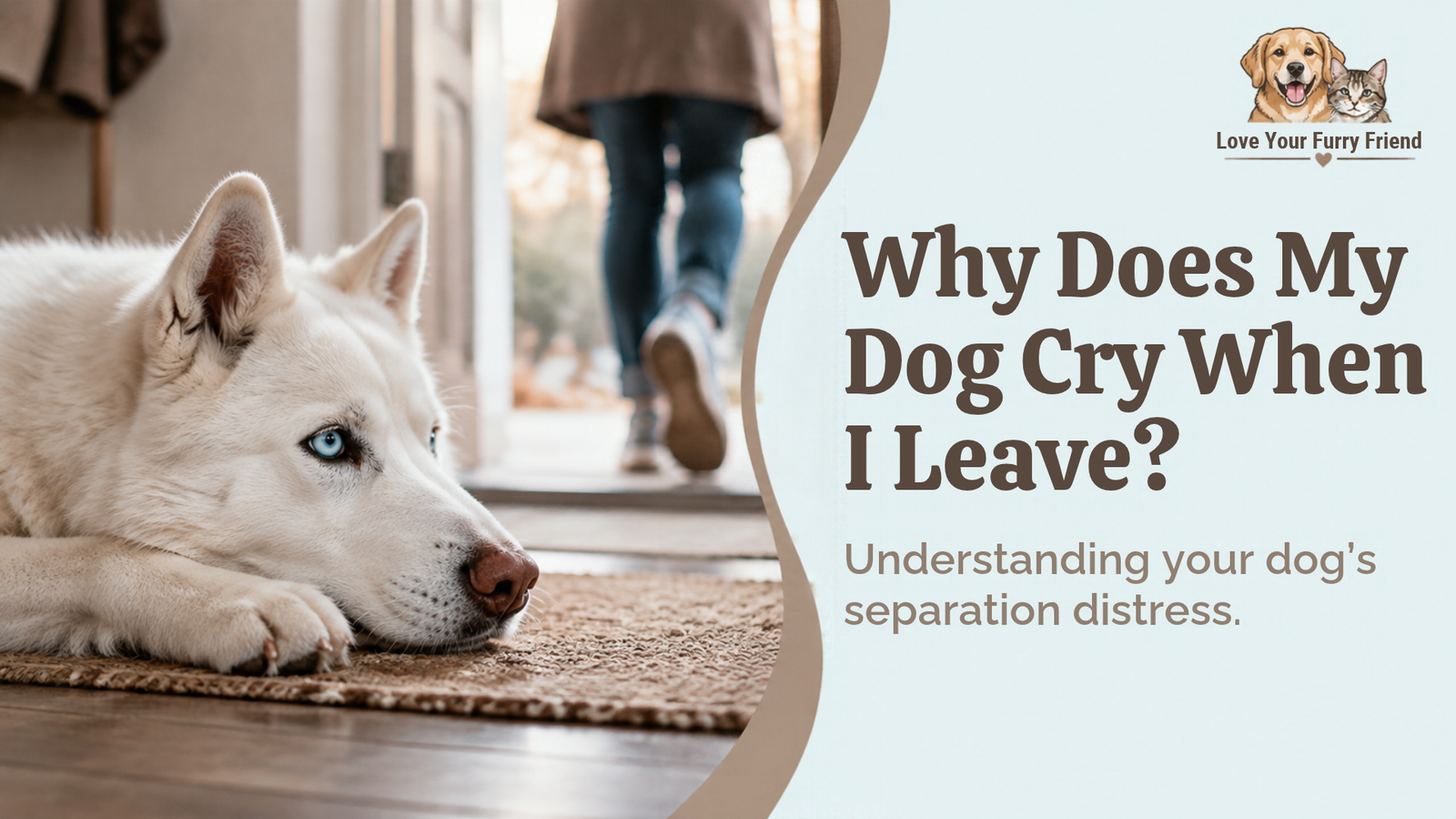
You pick up your keys.
Your dog lifts their head.
You put on your shoes, and suddenly they’re beside you—watching your face, following every movement and positioning themselves somewhere between you and the front door.
Then comes the whining.
Perhaps it starts before you leave. Perhaps you hear it as you walk down the path. Or perhaps a neighbour has mentioned that your dog cries when you’re out, and now every trip to the shops comes with a helping of guilt.
If you’ve been asking, “Why does my dog cry when I leave?”, the short answer is that your dog may be finding some part of being left difficult. That could involve separation anxiety, frustration, unfamiliarity with spending time alone, or something about the environment. Health problems can also influence behaviour, particularly when the change is sudden. Crying is a clue—not a diagnosis by itself.
The useful next step is not to find a way to silence the noise at any cost. It is to understand what happens around it.
In this guide, we’ll look at the possible reasons, the signs worth watching, and practical steps you can take without turning every departure into another stressful experiment.
A quick note before we begin: this article offers general information, not a diagnosis or an individual treatment plan. If your dog appears distressed, their behaviour has changed, or they could injure themselves, speak to your vet.
1. Why Does My Dog Cry When I Leave? The Possible Reasons
It is tempting to put every whine, bark or chewed door frame into the same box.
“My dog has separation anxiety.”
Sometimes that is the explanation. But dogs can struggle when left for different reasons, and the right support depends on understanding the individual situation. Dogs Trust uses the broader description “separation-related behaviours” when discussing problems that happen around being left alone.
They feel anxious about being separated
For some dogs, your departure is genuinely distressing.
The crying may come alongside pacing, trembling, panting, drooling, toileting indoors or attempts to get through a door. Some dogs become unsettled while you are still getting ready, because your coat, keys or usual leaving routine predict what happens next.
This is not a useful moment to think in terms of stubbornness or disobedience.
If your dog is anxious, the training goal is to change how they feel about the situation—not simply to demand quieter behaviour.
They have not yet learnt to feel comfortable alone
Spending time alone is something dogs may need help learning.
A puppy has recently left familiar company. A newly adopted adult dog is adjusting to a different home and routine. Neither necessarily arrives understanding that a closed door means a short, safe absence followed by your return.
Dogs Trust recommends introducing time apart gradually, increasing it only while the dog remains relaxed.
The distinction matters: being physically capable of staying in a room is not the same as feeling comfortable there.
Something about the setup is difficult
Sometimes the question is not only, “Does my dog dislike being alone?”
It may also be:
- Do they dislike being shut in that particular room?
- Can they hear people passing the front door?
- Are they watching dogs through the window?
- Have they lost access to their usual resting place?
Dogs Trust notes that restricted space and lack of choice can contribute to difficulty when a dog is left. A dog may respond differently in a safe, familiar room they normally choose to rest in than in an unfamiliar area used only during absences.
That does not mean opening every door will solve the problem. It means the environment deserves attention too.
Their routine—or health—has changed
A house move, different working hours or the loss of a companion can unsettle a dog’s routine. Medical conditions can also produce signs that overlap with anxiety, including restlessness and indoor toileting.
My starting point would be simple: if this behaviour is new, do not assume your dog has suddenly forgotten their training.
Ask what has changed, and include your vet in that conversation.
2. Watch the Whole Dog, Not Just the Noise
Crying is easy to notice.
The quieter signs can tell you just as much.
A dog standing silently at the door, panting and unable to settle, may still be struggling. Equally, hearing a short vocalisation does not tell you everything about the rest of an absence.
That is why watching your dog is more useful than relying on sound alone. Dogs Trust recommends video to help owners see what happens when they are not present.
What to look for
Watch for combinations of:
- Repeated whining, barking or howling.
- Pacing or repeatedly moving between doors and windows.
- Trembling, panting or drooling.
- Scratching or chewing around exits.
- Difficulty lying down and remaining settled.
- Ignoring food they would normally enjoy.
- Toileting indoors.
- Increasing agitation during your leaving routine.
No single item gives you a complete answer. The pattern is what matters.
Record useful information, not a stress test
A phone or home camera can help you gather information. Position it safely so you can see your dog’s usual resting area and, where possible, the relevant exit.
You do not need to leave a distressed dog alone for half an hour to prove there is a problem. If your dog is becoming upset, do not prolong the absence just to collect more footage; seek support and plan easier practice. Dogs Trust advises avoiding absences beyond what a dog can cope with.
Here is a simple observation sheet you can use:
| What to record | Example |
|---|---|
| What happened before leaving? | Put on coat and picked up keys |
| What did the dog do? | Stood up, followed, began panting |
| What happened after departure? | Walked between door and window |
| Was there an outside trigger? | Delivery at the front door |
| Did the dog eat or settle? | Left food untouched |
| What happened on return? | Took several minutes to lie down |
The examples are illustrative, not diagnostic.
Compare patterns rather than guessing
Imagine two dogs.
One begins pacing as soon as their owner reaches for the keys and remains unsettled after the door closes.
Another lies down comfortably, then starts barking when someone approaches the window.
Both owners may report, “My dog makes noise when I leave.” But those observations point towards different questions.
Your footage gives a vet or behaviourist something concrete to assess. It also replaces the exhausting cycle of guessing what happened while you were out.
3. What to Do Before Your Next Unavoidable Outing
Advice can sound wonderfully simple until you have an appointment at ten, a delivery to collect and nobody available to sit with your dog.
So let’s separate the long-term goal from the immediate problem.
The long-term goal is to help your dog feel comfortable with appropriate time apart.
The immediate goal is to reduce distress and keep them safe while you arrange that support. Dogs Trust recommends avoiding leaving an anxious dog alone where possible and using suitable help from friends, family or dog sitters.
Work out what company actually helps
Could someone your dog knows stay at home?
Could your dog spend time with a trusted person in a familiar place?
Would a suitable sitter cover the whole absence?
Think about what your dog finds comfortable, rather than choosing the first arrangement that fits the diary. If you are unsure whether an option suits your dog, discuss it with the professional supporting you.
Make the space safe and familiar
Before leaving, consider:
- Access to drinking water.
- A comfortable resting place your dog normally uses.
- A chance to go to the toilet.
- Removal of harmful objects and tempting valuables.
- Suitable, safe enrichment if your dog can use it comfortably.
- Secure doors and windows.
A safe space is not automatically the smallest available space.
If your dog becomes distressed behind a barrier or in a crate, do not assume tighter confinement is the answer. Dogs Trust warns that dogs panicking inside crates can injure themselves.
Keep departures ordinary
A calm goodbye is fine. You do not need to stage a long farewell—or pretend your dog does not exist.
Dogs Trust recommends making leaving and returning as uneventful as possible.
I would think of this as removing unnecessary drama, not withholding kindness.
And if you return to an accident or damage, skip the telling-off. Punishment does not address the distress behind separation-related behaviour and can add further worry around your return.
4. Build Alone-Time Confidence in Smaller Steps
One of the easiest traps is measuring progress only in minutes.
“Yesterday was two minutes. Today should be five.”
But the useful measure is whether your dog remained comfortable.
Gradual training works by introducing manageable experiences of separation and adjusting them to the dog’s response. Dogs Trust describes approaches including very short absences, changing associations with departure cues, and desensitisation and counter-conditioning.
Begin with something your dog can manage
For one dog, that might be resting while you move a few steps away.
For another, it might be staying comfortable while you briefly disappear from view.
A dog already distressed when you stand up needs an easier starting point than a dog who comfortably rests while you move around the house.
That is why a fixed timetable is not a substitute for an individual plan.
If you already know your dog panics during separation, involve a qualified behaviour professional rather than repeatedly testing how long they can endure it.
Pay attention to the leaving routine
Your dog may notice a sequence before you do:
Laptop closes. Shoes appear. Keys jingle. Door opens.
A professional may include work on these departure cues as part of the plan. The aim is to change what those signals predict, rather than have every coat-wearing moment announce an upsetting absence.
Keep this work manageable. Repeatedly presenting a cue that already worries your dog is not automatically helpful simply because you stay indoors afterwards.
Increase difficulty only when your dog is comfortable
Training may involve changes in distance, visibility and duration.
Try not to turn every successful repetition into an immediate demand for more. Dogs Trust’s guidance includes varying durations rather than making every practice progressively longer, and going back a step if the dog struggles.dogstrust
A useful question after practice is:
“Did that look comfortable?”
Not merely:
“Did we make it to the target?”
If distress appears, adjust the next attempt
If your dog starts pacing, whining or showing other signs of anxiety, the exercise needs reassessing.
Do not stand outside waiting for a prolonged silence while your dog becomes increasingly upset. Dogs Trust specifically advises that only returning when barking stops does not resolve how the dog feels about being left.
The next practice should be easier, with professional guidance where needed.
This is not about proving that you can outlast your dog. It is about creating experiences they can cope with.
5. Make Everyday Life Easier—Not Just Departures
Alone-time practice does not happen separately from the rest of your dog’s day.
Routine, exercise, mental stimulation and comfortable rest all belong in the wider picture. Dogs Trust recommends a predictable schedule, appropriate activity, enrichment and a safe resting space as supportive daily habits.
None of those things means a long walk or a new toy will cure separation anxiety.
They are foundations, not magic fixes.
Aim for a manageable routine
Your dog does not need every meal served at precisely the same minute.
But a broadly predictable rhythm can make life easier to navigate: opportunities to toilet, eat, move, interact and rest. Dogs Trust notes that consistent routines can help dogs feel safer.
I would favour a routine you can maintain over an ambitious schedule that lasts until Thursday.
Offer activities your dog genuinely enjoys
Suitable food toys, sniffing activities and other enrichment can support mental stimulation. Choose activities appropriate for your dog, and assess their safety before considering unsupervised use. Dogs Trust recommends safe, suitable enrichment and notes that a dog refusing food alone, despite enjoying it with company, may be anxious.
That last point is useful.
If you leave a favourite food toy and return to find it untouched, do not assume you simply need a more expensive toy.
It may be information about how your dog is coping.
Encourage comfortable independence without forcing it
When your dog chooses to rest on their bed while you read or work nearby, that can be a useful moment to support calm, independent activity. Dogs Trust recommends calmly praising independent settling and activities.
But independence should not become a contest in keeping your dog away.
The aim is a dog who can feel secure with some space—not a household where affection has become something to ration.
For readers who prefer having their next steps organised, this is a natural place to introduce The Systems guide.
Leave room for your own wellbeing
Living around a dog’s difficulty with separation can be exhausting.
You may be managing work, neighbours, childcare, appointments and the feeling that you cannot go anywhere without making arrangements.
Dogs Trust recognises that these situations can restrict owners’ lives and recommends seeking practical support and opportunities to take a break.
Getting help is not an admission that you care too little.
It is part of making the situation manageable for both of you.
6. Know When to Involve Your Vet or a Behaviourist
You do not need to wait for a destroyed door or a neighbour’s complaint before asking for support.
Dogs Trust recommends veterinary advice if you are concerned about separation anxiety, if behaviour has changed, or if your dog has become generally more fearful or dependent.
Book a health check when something changes
Your vet can consider whether a medical problem is contributing.
Some health conditions produce signs that resemble anxiety. Others may leave a dog less able to cope with situations they previously managed. Dogs Trust gives examples including sensory loss and conditions that cause restlessness or indoor toileting.
Bring your observations, even if they feel ordinary.
“When did it start?” and “What happens before the crying?” can be more useful than trying to arrive with the right diagnostic label.
Get qualified behavioural support for persistent distress
Seek help if your dog repeatedly:
- Becomes distressed during your departure routine.
- Cannot settle when you leave.
- Refuses food during absences.
- Scratches or damages exits.
- Tries to escape.
- Shows several signs of anxiety together.
Your vet can help you discuss appropriate referral options.
Professional support should help you understand the problem, choose a suitable starting point and adjust the plan—not merely provide a longer list of things to try.
Medication may be part of an individual plan
In some cases, medication can be useful alongside behavioural support.
That is a decision for your vet and, where involved, a clinical or veterinary behaviourist. It is not something to select from another dog’s experience or an online shopping recommendation. Dogs Trust notes that treatment decisions depend on factors including severity, welfare and the dog’s ability to begin training.
There is no need to frame appropriate veterinary treatment as failure. The question is what support this dog needs.
A practical first-week framework
Rather than setting a target of “leave for thirty minutes by Sunday”, use the first week to organise information and support.
- Write down what happens before, during and after departures.
- Gather short video clips without deliberately prolonging distress.
- Book a veterinary appointment if your dog appears anxious or behaviour has changed.
- Arrange suitable company for unavoidable outings where possible.
- Review the safety and comfort of the space your dog uses.
- Begin only manageable, comfortable practice appropriate to your dog.
- Review what you have learnt with your vet or behaviour professional.
This is a preparation framework, not a seven-day treatment programme. It follows the broader principles of observation, veterinary assessment, distress reduction and gradual training recommended by Dogs Trust.
A small amount of useful information is a better starting point than another week of random experiments.
7. Conclusion: Start With Understanding, Not a Stopwatch
When you find yourself asking, “Why does my dog cry when I leave?”, it is understandable to want an immediate answer.
You want to know your dog is comfortable. You also want to buy groceries, attend appointments and leave the house without feeling dreadful.
Start by looking beyond the crying.
Watch what happens around departure, consider the environment, and speak to your vet if your dog seems distressed or the behaviour has changed. From there, support can focus on manageable experiences of time apart rather than pushing through an absence your dog cannot cope with.
You do not have to solve everything today.
Your next step can simply be getting a clearer picture of your dog’s habits and the situations you want help with.
Our 2-minute dog behaviour quiz offers a starting point, with a personalised plan based on your answers. It is not a diagnosis or a replacement for veterinary or qualified behavioural care.
Take the quiz and see your dog’s personalized plan here:
Frequently asked questions
1. Should I let my dog cry it out when I leave?
Do not use prolonged distress as a training method. Dogs Trust advises against simply leaving a dog to bark when they struggle with being alone, because the underlying emotional difficulty still needs addressing. Work towards absences your dog can manage, and seek qualified help if they are distressed.
2. Why has my dog suddenly started crying when left alone?
Possible factors include a change in routine, moving home, the loss of a companion or a medical problem. Rather than assuming the cause, note when the change began and arrange a veterinary check. Dogs Trust recommends seeking advice for new anxiety or changes in behaviour.
3. Will a crate stop my dog crying when I go out?
A crate does not treat the underlying fear of being left. Some dogs find confinement difficult, and a dog who panics inside a crate may injure themselves. Any use of a crate as a resting space should be introduced positively and considered in relation to that individual dog’s response and support plan.
4. Would getting another dog help with separation anxiety?
Another dog is not a reliable solution. Canine company may reassure some dogs, but it does not necessarily resolve separation anxiety, and adding a dog can introduce further difficulties. Dogs Trust recommends addressing the existing problem before considering another dog.
5. How long does dog separation anxiety training take?
There is no dependable timetable that applies to every dog. Progress depends on the underlying difficulty, its history, the dog’s circumstances and the support available. Some dogs progress relatively quickly; others need weeks or months. Aim for comfortable, sustainable progress rather than a deadline.