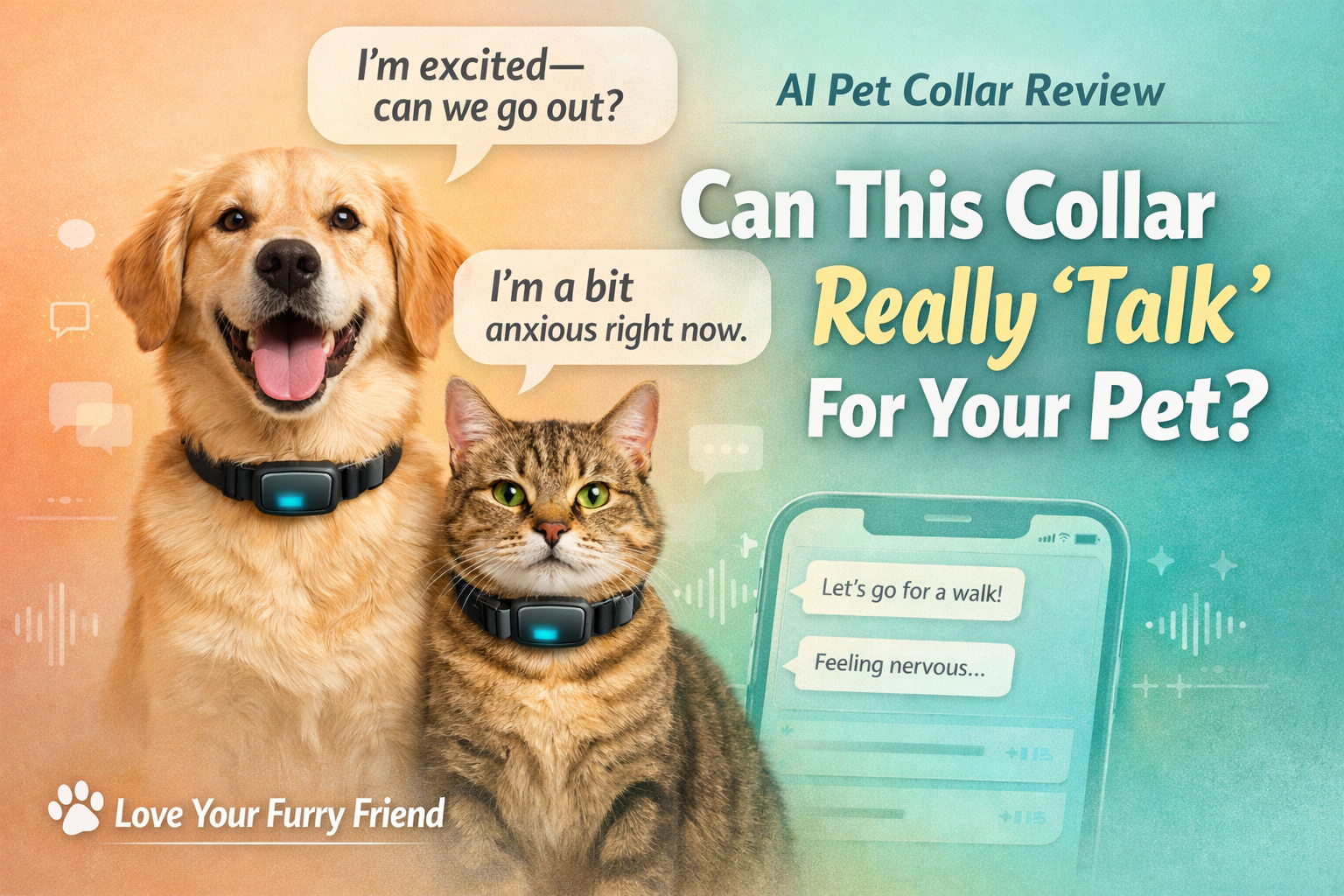
I tested a gadget that claims 95% accurate pet translation; here’s what actually happened with my furry friend.
As someone who’s been reviewing pet products and tech for almost 19 years, I’ve seen everything from genuinely helpful tools to pure gimmicks designed to go viral on social media. This PettiChat review sits somewhere in the middle: it’s not a magic mind‑reading device, but it can be a lot of fun and surprisingly thought‑provoking if you go in with the right expectations.
Before we get into what happened with my own furry friend, a quick but important disclaimer: PettiChat is a playful consumer AI device with unverified scientific claims. It should be treated as entertainment and a behavioural “hint system,” not as a proven way to decode your dog’s or cat’s inner thoughts or replace proper training and vet care.
With that out of the way, let’s talk about what this collar actually does, how it behaves in a normal home, and whether it’s worth your money if you love pet tech and want to better “understand” your pet—at least in a fun, experimental way.
What Is PettiChat, Really?
PettiChat is marketed as an AI pet collar plus app that listens to your dog’s barks or your cat’s meows and then turns them into simple human‑language phrases on your phone. It also claims to work in the other direction: you speak into the app, and it plays sounds designed for your pet, based on the emotional intent of what you said.
In plain English, think of it as a “mood translator” rather than a strict language translator. Instead of saying, “My dog is pondering the meaning of life,” PettiChat is more likely to show something like “I’m excited!”, “I’m nervous,” or “I’m hungry” based on the sounds and movement it picks up.
The collar talks to a companion app, where you see live “translations,” emotion tags, and a history of what it thinks your pet has been feeling. Some versions also layer in extras like GPS tracking and geofencing, which can be genuinely useful if your pet is prone to wandering.
From an SEO perspective, pet owners search for phrases like “PettiChat review,” “AI pet collar,” and “can I really talk to my dog with technology?” so this kind of detailed, practical review helps you answer all of those questions in one place.
My First Impressions: Fun, But Temper Your Expectations
After nearly two decades of testing pet products, my instinct with something like PettiChat is always the same: assume the marketing is over‑excited and then see how it does in real life.
When I first set up the collar on my furry friend (Bella), the onboarding was straightforward. You pair the collar with the PettiChat app, enter basic details like species and size, and then you’re ready to go. The collar sits fairly lightly on the neck; it doesn’t feel like a heavy gadget hanging off your pet, which is important if they’re sensitive to collars.
Within minutes, the app started registering Bella’s barking and movement. When a delivery driver approached the door, the collar fired off phrases like:
- “I’m alert!”
- “Someone’s here!”
- “I’m excited!”
Was that exactly what Max was “saying”? Of course not in any scientific sense—but it did match his behaviour. Tail stiff, ears forward, pacing back and forth at the front door. For a family that isn’t as experienced at reading dog body language, this kind of emotional labelling can be a nice bridge between what the dog is doing and how humans interpret it.
My honest first impression: PettiChat is entertaining and occasionally insightful, but it’s not the miracle that some viral clips may make it look like. Go in expecting “smart guesses” rather than perfect translations.
Accuracy: 95% Claim vs Real‑World Feel
The headline claim that grabs attention is simple: around 95% accuracy. That number is the hook for most people reading a PettiChat review—because if it were true in the strict sense, we’d practically be talking to our pets.
In the real world, I’d break it down like this:
- Emotional categories are often roughly right. When Max was calm and resting, we saw outputs like “I’m comfortable” or “I’m relaxed.” When he was whining near his food bowl, it leaned into “I’m hungry” or “Feed me, please.” That feels directionally correct.
- Context matters a lot. If you’re playing fetch and your dog barks, getting “I’m excited!” makes sense. If your dog barks at a stranger, you might see “I’m nervous” or “I’m on guard.” The collar is reading not just sounds, but also motion and timing.
- Literal phrasing is less important. Sometimes the sentences feel cheesy or a bit too “TikTok ready.” I’d recommend focusing on the emotion behind the phrase (excited, anxious, stressed, playful) and not on the exact wording.
As someone who’s watched pets closely for years, I wouldn’t personally put the real‑world feel at 95% accuracy, but I would say it often lands in the right emotional ballpark. When you treat PettiChat as a tool to spark curiosity—“Why is my dog barking right now?”—it can add an extra layer of interpretation that gets families talking about behaviour instead of just saying “oh, he’s noisy again.”
Can PettiChat Really “Talk” For Your Dog Or Cat?
Here’s the core question of this PettiChat review: can this AI pet collar really “talk” for your dog or cat?
My answer, from 19 years of practical experience, is: it can simulate “talking” in a way that’s fun and sometimes meaningful, but it is not genuine language translation. You’re not decoding complex sentences from your pet, and you’re not suddenly learning hidden secrets you could never have seen with your own eyes.
What PettiChat does well is:
- Turn subtle emotional signals into clear, readable outputs. For less experienced owners, seeing “I’m stressed” vs “I’m excited” can be genuinely helpful.
- Encourage you to notice patterns. If your cat’s collar regularly reports “I’m anxious” at certain times of day, you might start asking, “What’s happening around then? Is it noise, other pets, children, or something else?”
- Create fun moments of “shared humour.” When Max barked because he wanted to chase a squirrel and the app produced “Let me chase it, come on!”, everyone laughed because it matched what we already knew about him.
Where you need to stay grounded is in remembering that PettiChat is guessing based on sounds and movement. The target keyword “PettiChat review” is really about your experience plus this understanding: you’re evaluating an entertainment‑first device, not a scientific instrument.
So yes, PettiChat can “talk” for your pet in a playful, human‑friendly way—but it’s more like a voiceover artist for your dog or cat than a translator in a courtroom.
Daily Use: What It’s Like Living With PettiChat
Living with PettiChat for a while gives a clearer picture than just a quick demo. Here’s what stood out to me over time.
1. It’s best in short, fun bursts
You get the most value when you use it during specific situations: playtime, walks, greetings at the door, or those strange moments when your pet seems agitated and you’re not sure why. Leaving it on 24/7 quickly turns into notification fatigue, especially if your dog is vocal.
2. It can help kids understand pets better
In a family setting, this is where PettiChat shines. Kids often struggle to interpret body language, so seeing phrases like “I’m scared” or “I’m excited” can start important conversations about respecting animals’ boundaries. A PettiChat review that looks at family dynamics will often find that the device acts like a teaching tool for empathy.
3. It encourages you to observe more
I noticed that, over time, I was actually paying more attention to Max without the app. It pushed me to ask, “Is that output fair? Does his body language match what the collar says?” That alone is valuable. Anything that gets owners watching closely is a win for the pet.
4. The novelty eventually settles
Like any gadget, the “wow” factor is highest on day one. After that, PettiChat becomes something you pick up for specific scenarios, or when you want to show guests what this “pet translator” can do. That’s fine—as long as you’ve bought it for entertainment and light insight, not life‑changing revelations.
Who Is PettiChat Best Suited For?
In my view, PettiChat is a great fit for certain types of pet owners and not such a good fit for others.
Great fit
- Tech‑curious pet owners who already enjoy smart collars, GPS trackers, and app‑based tools.
- Families with children who are learning how to interact kindly and safely with dogs or cats.
- Content creators and social media users who want fun, shareable moments of “My dog just said THIS.”
- Pet lovers who see this as a toy plus a conversation starter, not a scientific breakthrough.
Not ideal
- Owners looking for serious behavioural diagnosis or training solutions. This is not a replacement for a qualified trainer or behaviourist.
- People who dislike notifications or any kind of data‑tracking around pets.
- Anyone expecting literal mind‑reading. You will be disappointed if you expect PettiChat to tell you deep secrets—your dog’s favourite philosopher is still a mystery.
If your mindset is, “I want a playful, modern device that helps me think more about my pet’s emotions,” this PettiChat review probably pushes you towards “yes, it’s worth trying.” If you’re hoping for strictly scientific accuracy, I’d suggest saving your budget for training, enrichment toys, or health‑related tools instead.
Price, Value, And Final Thoughts
Let’s talk value, because that’s central to any honest PettiChat review. You’re paying for three things:
- The physical collar hardware.
- The ongoing access to the app and its emotion/translation features.
- The entertainment and insight you get, especially when sharing with friends, family, or followers.
Is it “worth it”? That depends entirely on why you’re buying it.
- If you want solid entertainment, occasional “aha” moments, and a way to frame pet emotions in everyday language, PettiChat delivers enough to justify the purchase, especially if you catch it on discount or via a referral offer.
- If you want a clinical tool or something that genuinely proves 95% scientific accuracy, this is not it. You’ll feel misled if you treat the marketing as hard science.
With 19 years of experience behind me, I’ve learned that the best pet products either make life easier, make pets happier, or help humans pay better attention. PettiChat mostly lives in the third category: it nudges people to notice what their pets might be feeling and makes that process more fun and shareable.
If that’s the kind of relationship you want with your pet—and you don’t mind a bit of tech‑powered theatre along the way—then trying PettiChat could be a fun experiment for you and your furry friend.
Conclusion: Should You Try PettiChat?
So, can this AI pet collar really “talk” for your dog or cat? In the strict sense, no—it’s not reading their inner monologue. But as a playful, consumer‑grade gadget that attempts to turn barks and meows into emotional phrases you can understand, PettiChat can absolutely add some fun, curiosity, and extra awareness to your life with your pet.
Treat it as entertainment with a side of insight, keep your expectations grounded, and you might find yourself laughing at some strangely accurate “translations” and paying more attention to your pet’s behaviour.
If you’re ready to experiment and see what PettiChat has to “say” about your own furry friend, go ahead and give it a try. Just remember: your pet’s real voice is still in their eyes, posture, and everyday habits—and this collar is best seen as a playful narrator, not a mind reader.
Give PettiChat a try and see what your furry friend “has to say” — you can test it for yourself through my link here. PettiChat 50% Off
FAQs About PettiChat
1. Is PettiChat scientifically proven to translate pet language?
No. PettiChat is based on pattern recognition from sounds and movement, but it is not backed by peer‑reviewed scientific proof of true language translation. It should be seen as an entertainment‑focused tool with educated guesses about emotion.
2. Can PettiChat help with training my dog or cat?
Indirectly, yes, but it is not a training device. It may help you notice when your pet is stressed or excited, which can inform your training sessions, but proper training still relies on consistent human guidance and, ideally, professional advice.
3. Is PettiChat safe for pets to wear?
The collar is designed to be lightweight and pet‑friendly. As with any wearable, you should make sure it fits correctly, doesn’t rub, and doesn’t interfere with normal movement. Always monitor your pet when introducing new gear and remove it if you notice discomfort.
4. Does PettiChat work better for dogs or cats?
Most users report more obvious results with dogs, simply because dogs tend to vocalise and move more in ways that are easier to interpret. It can still be used with cats, but the feedback may feel less frequent and sometimes more ambiguous, especially with quieter or more reserved cats.
5. Is PettiChat worth the price?
If you’re buying it for fun, family bonding, social content, and a bit of extra insight into your pet’s emotional state, it can be worth the cost. If you’re expecting a proven scientific tool, or if your budget is tight, you might want to prioritise training, enrichment, or health products instead.